Identifying and Attracting Backyard Birds to your Garden with Videos
One good reason for attracting backyard birds to your garden is that they eat lots of garden pests. Identifying wild birds in your backyard is an art but easy when you know how. See the videos on various aspects of bird identification.We should encourage backyard birds to visit our gardens and homesteads as they eat up to garden pests a day that harm our orchards and homestead crops. So how do we do that?
The Importance of Backyard Birds
First of all, we should look at what backyard birds do in the world? This is an important question for us to think about. Think of what the birds are doing on every farm, ranch and homestead, in every garden and backyard, and about every home in the land.
Think of the birds that have beautiful feathers, such as the Birds of Paradise, or the many types of colorful parrots. However, not everyone has these birds in their backyard. Despite this, there are many birds in your garden that are just as beautiful and who have lovely song.
However, birds are not here just to look and sound beautiful. That is not their only purpose. Aside from these services the greatest work of birds is to destroy garden pests and insects. It is one of the wise provisions of nature that many of the most brilliantly winged and most enchanting songsters are our most practical friends.
Not all birds feed on insects, garden pests and animals; but even those that eat but a small amount of insect food may still destroy insects that would have damaged fruit and crops much more than the backyard birds themselves do.
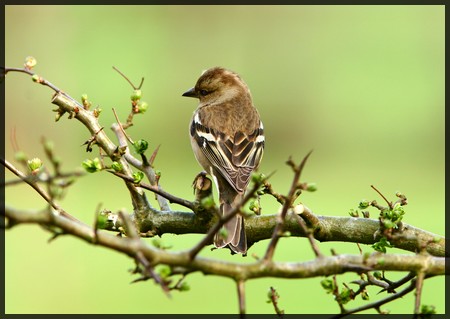
A Female Chaffinch picture copyrighted to Marilyn Barbone
Three Types of Backyard Birds
Backyard birds are divided into three general classes according to what they eat.
- First, those that live wholly or almost wholly on insects. These are called insectivorous birds.
- Chief among these are the warblers, cuckoos, swallows, martins, flycatchers, nighthawks, whippoorwills, swifts, and humming-birds. We cannot have too many of these backyard birds. These birds should be encouraged in the garden and protected. They should be supplied with shelter and water.
- Birds of the second class feed by preference on fruits, nuts, and grain. The bluebird, robin, wood thrush, mocking-bird, catbird, chickadee, cedar-bird, meadow lark, oriole, jay, crow, and woodpecker belong to this group. These birds never fail to perform a service for us by devouring many weed seeds.
- The third class is known as the hard-billed birds. It includes those birds which live principally on seeds and grain—the canary, goldfinch, sparrow, chaffinch, and some others.
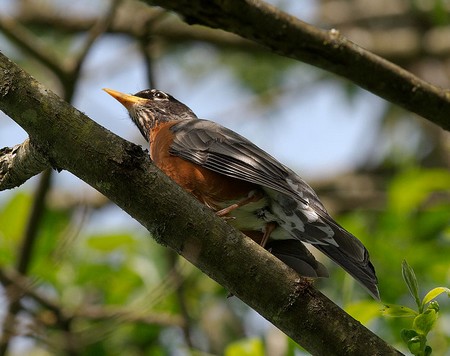
A Common Backyard Bird - An American Robin
Birds that come early,
like the bluebird, robin,
and redwing,
are of
special service in destroying insects and garden pests before the
insects lay their eggs
for the season.
During the winter the bark
is the hiding-place for hibernating insects,
which, like plant lice, feed in summer on the leaves. Throughout the
winter a single chickadee will destroy great numbers of the eggs of the
cankerworm moth and of the plant louse.
The blackbirds,
meadow larks,
crows, quail, and sparrows
are the great protectors of the meadow and
field crops. These birds feed on the army worms and cutworms that do so
much injury to the young shoots; they also destroy the chinch bug and
the grasshopper, both of which feed on cultivated plants.
A count of all the
different kinds of animals shows that insects make up
nine tenths of them. Hence it is easy to see that if something did not
check their increase they would soon almost overrun the earth. Our
forests and orchards furnish homes and breeding-places for most of
these
insects.
Suppose the insects were allowed to multiply
unchecked in the forests, their numbers would increase so much that
they
would invade our fields and create as much terror among the farmers as
they did in the day of Pharaoh's Egypt. The birds are the only direct friends man
has to destroy these harmful insects. What benefactors, then, these
little feathered neighbors are!
It has been estimated that
a bird will eat 30
insects a day. Even
in a widely extended forest region a very few birds to the acre, if
they
kept up this rate, they would destroy many thousands of insects that
would normally play havoc with the neighboring orchards and fields.
Identifying Backyard Birds in your Garden
There are a couple of features to take into consideration when identifying backyard birds. These are:
- Color and Markings
- Bill shape
- Behavior
- Habitat
- Making Comparisons
The best way to identify birds in your back garden is through keen observation. By really looking at the birds in your garden looking at the above characteristics can you then help to identify them better. Finally, if all else fails, get yourself a good field guide to your local bird life and do some solid research.
Color and Markings
The feather markings, markings on the tail, around the eyes, the color of the beaks or bills and even the color of the legs will give you some hints as to the type of bird you may be looking at.
Bill Shape
The bill shape will give you an idea of they type of food your bird eats. Also look at the length of the bill and the shape.
Behavior of your Backyard Birds
Look at your birds and see what they are using for nesting material. What trees do they like to sit in and is it because there is a nut or fruit that they enjoy eating. What are they eating in your garden? Are they picking up worms from the grass or are they eating insects from the bark of trees. Perhaps they are corn eaters or fruit eaters? Also listen to its call and song.
Habitat Where do your birds sleep at night? Do they sleep on or close to the ground in thick brush or do they sleep in the upper branches of the trees. Do they sleep in holes in the trees? Are there any clues that they are water fowl? Are they living close to fresh or salt water or even marsh land?
Building Bird Houses for your Backyard Birds
 Birds
in your backyard
are not just useful for destroying harmful insects. The day is made
more delightful when the birds sing, and when we
see them flit in and out or the trees, giving us a glimpse now and then
of their
pretty coats and quaint ways.
Birds
in your backyard
are not just useful for destroying harmful insects. The day is made
more delightful when the birds sing, and when we
see them flit in and out or the trees, giving us a glimpse now and then
of their
pretty coats and quaint ways.
By building bird houses for them we can surround ourselves with many birds, sweet of song and brilliant of plumage.
If the birds felt that man were a friend and not a foe, they would often turn to him for protection.
During times of severe storm, extreme drought, or scarcity of food, if the birds were sufficiently tamed to come to man as their friend, as they do in rare cases now, a little food and shelter might tide them over the hard times and their service afterwards would repay the outlay a thousandfold.
If the boys in your families take to building bird houses about the homestead, garden and barn and in shade trees, they might save yearly a great number of birds.
In building bird houses and places of shelter and comfort, due care must be taken to keep them clear of English sparrows and out of the reach of cats and bird-dogs.
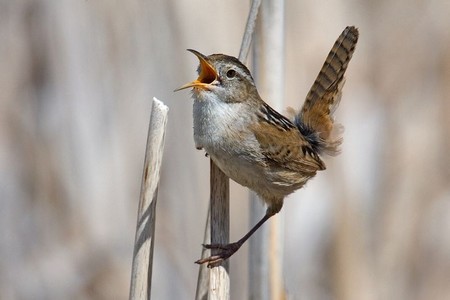
A Marsh Wren

Attracting Backyard Birds to your Garden
It is an interesting study—the preparation of homes for the birds. Trees may be pruned to make inviting crotches. A tangled, overgrown corner in the garden will invite some birds to nest.
Wrens, bluebirds, chickadees, martins, and some other varieties are all glad to set up housekeeping in man-made bird houses. The proper size for a bird-room is easily remembered. Give each backyard bird room of six square inches of floor space and make the birdhouse eight inches high.
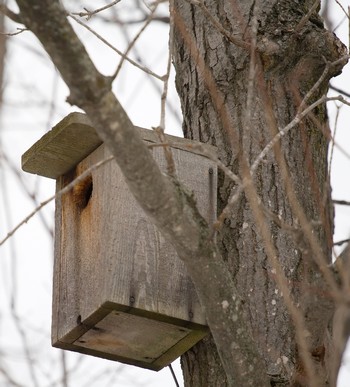
Old, weathered boards should be used; or, if paint is employed, a dull color to resemble an old tree-trunk will be most inviting. A single opening near the top should be made two inches in diameter for the larger birds; but if the bird house is to be headquarters for the wren, a one-inch opening is quite large enough, and the small door serves all the better to keep out English sparrows.
If you are thinking about building bird houses we have a plan for a purple martin bird house.
If you are homesteading the barn attic should be turned over to the swallows. Small holes may be cut high up in the gables and left open during the time that the swallows remain with us. They will more than pay for shelter by the good work they do in ridding the barn of flies, gnats, and mosquitoes.
10 Do's and Don'ts for Building Nest Boxes for Backyard Birds
1. If you have introduced nest boxes to your garden make sure that the lids are secure so that squirrels, magpies and other animals are not able to steal the eggs.
2. Nest boxes should be placed out of the wind, rain and full sun. If the nest box is not placed out of the sun the chicks will overheat and they will die.
3. Boxes should also be postioned where cats cannot get to them. However, the nest boxes should be placed conveniently close to a tree or shrub with small branches so that the fledglings - and the fledglins only - can perch on them.
4. If you make your own nest boxes, don't add a perch. Larger birds may come and scare away the nesting birds.
5. If you want to make or buy a bird box for blue tits the hole should be roughly 2.5 cm in diameter. For slightly larger birds like great tits and sparrows the hole should be about 3.5 cm.
6. Make your nest boxes from untreated wood.
7. Don't put any nesting materials inside the nest box as birds prefer to bring in their own material.
8. It is essential to clean out bird boxes with boiling water in the fall, otherwise diseases and parasites will be passed on to other birds nesting there.
9. The best time to put up a new nest box is in the early fall, which is the time that birds start looking for nesting homes. Don't give up if your nesting box isn't lived in, in the first year.
10. If you are planning to put up a number of nest boxes don't place them too close together as the birds like their own space.
Buy Birdhouses and Bird Feeders. Click on the birdhouses and bird feeders below for more details.
Videos on Identifying Backyard Birds
Identifying Birds in your Backyard by Color and PatternColor and plumage patterns are key components of bird identification. Improve your birding skills by watching Lab experts as they demonstrate how to recognize the color patterns that will help you identify birds with confidence.
Identifying Birds in your Backyard by Size and Shape. Learn the most fundamental skill for identifying birds: recognizing them by size and shape. Birding experts Chris Wood and Jessie Barry show you how to compare different birds and employ your observations to make a confident ID.
Identifying Birds in your Backyard by Habitat Join birding experts Jessie Barry and Chris Wood as they explore the marshes, cypress swamps, and nearby mangroves of Florida's Loxahatchee National Wildlife Refuge in pursuit of the elusive Limpkin.
Identifying Birds in your Backyard by Behavior Recognizing behavioral clues is a key component of bird identification.
Improve your identification skills by watching Lab experts as they examine posture, foraging behavior and flight style.
Online Bird finder
Add your Comments on Backyard Birds Here!
We have lots of pages where you can contribute to throughout this homesteading website, as you can see from the links below. We love hearing from our readers, and hope you will be one of those we hear from too. Please share any additional information, or ask a question about backyard birds here, so that other may learn too! Just type in the form below, we will do the rest.
Leave a Comment
Do you have anything that you would like to add after reading this page? We would love to hear your thoughts. If you can add additional information to what has been written here you will be adding value to the website! No need to have any special skills - just type and submit. We will do the rest!
Don't miss out on our latest news and articles. Sign up for our free monthly e-zine!
NAVIGATION COLUMN
Find us on Google+Country Shopping
Country StoreFree Stuff
Free MagazinesHomesteading Blogs
Country Living Blog Gypsy's WanderingsCountry Living
Country Home Country Living Country Crafts Country HolidaysCountry Real EstateCraft ForumPicnics CampingSelf-Sufficiency
Self-Sufficient Living Organic Gardening Do It Yourself Easy RecipesHomesteading
Homesteading Today Homesteading Q & A Homestead Animals Urban Homesteading Homestead DirectoryGoing Green
Green LivingFarms Around the World
South Africa United Kingdom United States Canada Central America Australia New Zealand Europe Farm Photos Farming Articles True Farming Stories Farms for Sale Organic Farm ProduceMiscellaneous
Guest Book Search Site Survey Advertise with Us


New! Comments
Do you have something of value to add? Leave me a comment in the box below.