Advantages and Disadvantages of Planting Dwarf Fruit Trees
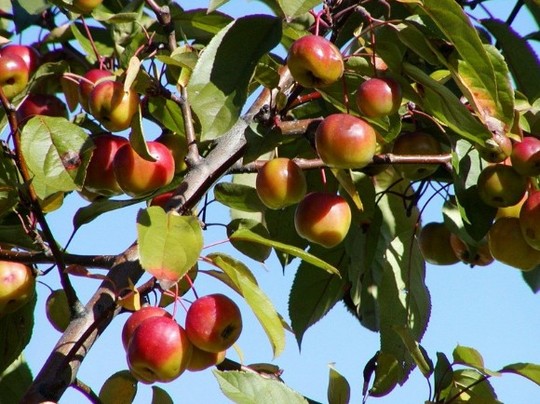

Dwarf fruit trees are ideal for small spaces. They spread their branches in a ten-foot circle and can reach a height of 8-10 feet. As a result, you can plant several of these miniature fruit trees in an area that you would normally only plant 1 tree. You can also easily reach the fruit to pick and eat, to use in food preparations, or to preserve.
The ideal growing conditions for these miniature fruit trees are full sun and well-drained, fertile soil. However, a half-day of sun is also fine. Fruit trees will do well in soil where most crops fail, and ordinary drainage is adequate.
Planting your Dwarf Fruit Trees
If you have at least a partially prepared hole ahead of time, you need to make sure that it is wide and deep enough to avoid crowding the roots and of a depth so that the graft (where the changes or trunk is slightly offset) is easily above the ground. If grafted portion (and above) is underground, it can put forth roots and develop into a standard size trees.
Soak the dwarf tree roots in a trash can or another large container for a minimum of two hours and a maximum of 24 hours before planting. Place a tree in the hole, carefully surrounding the roots with fine topsoil, mixed with up to 1/3 peat. Add some well-rotten farmyard manure as well as a handful of bone meal to the hole.
Tramp down to avoid air pockets, fill hole to 2 inches below ground level. Water the tree, giving a deep thorough watering. Finish filling the hole to ground level.
To protect tender bark from rabbits and mice, wind 20 inch plastic spiral, made for this purpose, around the trunk from the ground up. Pile sawdust around the base.
About an inch of rainfall every 10 days or so is adequate. But in dry weather, a good soaking with a slow trickling garden hose is beneficial. A soaking every 10 days or 2 weeks is enough, and generally, it is not necessary after the first growing season except in areas dependent upon irrigation for normal plant growth.
Keep soil on the surface worked up loosely in spring and in the summer cover with 4 – 6 inches mulch. Remove mulch in later fall or early winter. Fertilize regularly until the first week of July, then allow new growth to mature before the frost. Any suckers that appear near the ground should be cut off.
Growing dwarf fruit trees come in a number of varieties and you can choose apples, apricots, peaches, pears, nectarines, cherries and plums.
Check with you nurseryman to see what fruit trees will grow in your climate zone and which trees need companions for pollination.
Advantages of Growing Dwarf Fruit Trees
Dwarf fruit trees usually begin to bear one to three years sooner than standard-size trees. They rarely grow more than 10 feet which allows you to harvest your fruit a lot easier than full-sized trees. They are also heavy bearers despite their size. My favorite miniature fruit tree is called the Fruit Salad tree which has a number of different fruits grafted on to one tree - perfect for that patio or balcony where spaces are small.They are also easier to prune, train, spray, thin, pick and protect from frost and birds. and as mentioned above, ideal for growing in small spaces.
If you have a backyard where you would only be able to plant 3 or 4 standard trees, in its place you could grow 40 - 50 dwarf fruit trees. For those of you who have a quarter of an acre, where you would be able to grow less than 12 standard fruit trees in such an area, you would be able to grow 300 - 500 miniature fruit trees.
If you have just a small garden of flowers and shrubs, miniature fruit trees are ideal to grow in amongst the flower beds.
If you live in a rented property and you plant fruit trees you don't know always how long you will be renting for. As a result, planting miniature fruit trees is the answer as they will invariably bear in the second year of planting.
For many of us who erect fences around our property we often look to the types of hedges or shrubs we could grow to hide the ugly metal. Miniature fruit trees are ideal for this, especially trees that grow upright such as pears or plums. Growing dwarf fruit trees upright, two feet apart soon creates the perfect screen.
Disadvantages of Growing Dwarf Fruit Trees
Propagating dwarf fruit trees is not an easy exercise, as a result, the trees themselves are more expensive than standard fruit trees. This is especially seen when you want to plant a lot of them as a hedge or in an orchard.Some dwarf fruit trees have a very poorly developed root system and may need staking or trellising, especially if you live in a windy area.
Therefore, the value of pruning at planting time should not be underestimated. The tree lost many feeder roots when dug at the nursery, but the top is still full size and not in balance with the roots. Pruning stimulates growth and shapes the tree and should be done, just as one would prune standard species.
Did you find this page helpful?
Sharing is a way of saying, "Thanks!"
Follow Us and Keep Up to Date
Don't miss out on our latest news and articles. Sign up for our free monthly e-zine!


OTHER SECTIONS OF INTEREST
 Natural
Pesticides
Natural
Pesticides Garden
Pests
Garden
Pests Codling
Moth
Codling
Moth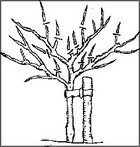 Planting,
Pruning Fruit Trees
Planting,
Pruning Fruit Trees Self
Sufficient Living
Self
Sufficient Living
Container Gardening
New! Comments
Do you have something of value to add? Leave me a comment in the box below.