Growing Rhubarb : How to to Grow Rhubarb - Plants, Seeds, Harvesting
Rhubarb is an old-fashioned plant that has been mainly used throughout the ages, and especially by the Chinese, as a medicinal plant, usually as a laxative. It is only over the last couple of hundred years that rhubarb has been cultivated for eating purposes.
However, it is well known that the leaves contain oxalic acid which is poisonous to man, and although you would need to eat a lot of the leaves to end up at a sticky end, they will give you a very bad upset stomach if you do end up eating them by mistake. Therefore it is only the stems of this rhubarb plant that we can eat.
This also applies to livestock. Never feed your chickens or other livestock rhubarb leaves at any time, however you can add them to the compost heap.
The rhubarb plant is a perennial. And although it is classified as a vegetable, in the USA it is classified as a fruit, and it will grow quite happily in your garden year after year. If the soil is particularly good it can spread over 3 - 4 feet and grow just as high. So remember this when spacing out your seedlings!
Soil Preparation and Growing Rhubarb
Good soil preparation is the key. Rhubarb plants are heavy feeders so before planting, dig compost, manure and blood and bone into the soil. Water well and leave for a week to 10 days before planting.
Prepare the bed in early spring and add at least 3 inches of well-rotted farmyard manure to the bed. Poultry manure and good compost is an excellent mix.
They will grow in any type of soil, however, if they soil is light and rich with humus and in a sunny and open area your rhubarb will thrive. Rhubarb grows very well in moist soil, although it will not be happy when its feet are too wet.
During
the growing season you can, once a month, feed your plants with seaweed
fertilizer and fish emulsion which will encourage stem formation. It is
almost impossible to overfeed rhubarb.
When to Plant Rhubarb
Your rhubarb seeds should be sown in spring and your first harvest should be late spring, early summer the following year.
You can forced in mid-winter by placing a bucket upside down over the rhubarb plant. All daylight must be shut out and a thick mulch should be placed around the rim of the bucket. By doing this the stalks should be ready to be harvested in about 3 weeks.
The plant can be re-covered to force more stalks, but once used this way the plant should be discarded as it will take a long time for it to recover.
Climates and Growing Rhubarb
Rhubarb grows best in cool, temperate regions with a good rainfall. It can be grown in the subtropics in cooler, elevated regions, but it is not suitable for the coastal sub-tropics or the tropics.
Rhubarb needs good drainage, but it also needs plenty of water in hot, dry weather. Regular watering during dry spells is important and an application of manure during winter, prior to the growing season, will ensure strong new-season growth.
If you can plant your crop in an area where it gets a full morning sun with afternoon shade this is ideal.Growing Rhubarb from Seed
Growing rhubarb from seed is one of the easiest ways of cultivating rhubarb, however growing rhubarb from crowns will result in better reliability. Although most rhubarb shouldn't be harvested the first year the variety "Glaskin's Perpetual" is one rhubarb variety that you can start picking in the first year.
Simply sow the seeds outdoors in shallow drills or indoors in trays or boxes during spring. Thin or transplant them to 6 inches apart, and when they begin to touch transplant them out to about 3 feet apart.
Growing Rhubarb by Crowns
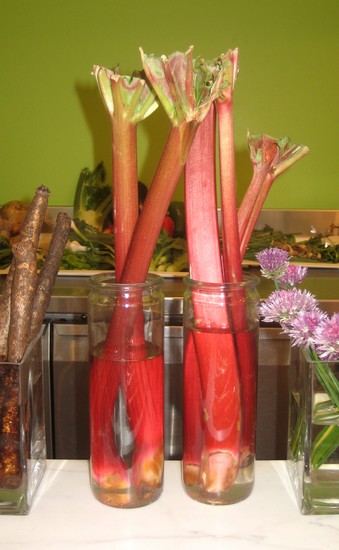 The rhubarb plant, when
purchased from the nursery, comes in the form of rhubarb crowns. Again,
one should wait at least a year before harvesting your rhubarb.
The rhubarb plant, when
purchased from the nursery, comes in the form of rhubarb crowns. Again,
one should wait at least a year before harvesting your rhubarb.
Prepare the holes for your rhubarb so that the hole is just deep enough to allow small shoots to protrude from the surface of the soil, and wide enough to take the whole rootstock.
Plant the young rhubarb crowns at 3 feet apart.
When planting your rhubarb, make sure that the crowns are at soil level.
Cover crowns with a thin layer of soil and firmly press them down into place. Water in well and mulch with compost, lucerne or pea straw. Keep mulch away from the crown to discourage rot.
Top dress the soil with well-rotted farmyard manure or homemade compost each winter or early spring.
Lightly fork this into the surface. Feed with a liquid fertilizer every summer. After 4 years lift the crowns and after dividing them into smaller plants during spring and replant.
Rhubarb Flowers and Growing Rhubarb
Never let your plants go to flower. If you see any flower
stems appearing, cut them off.
Growing Rhubarb and Dividing the Clumps
Dig up and divide the clumps every 4-5 years, preferably in the winter. Use a fork or spade to dig the whole clump from the soil. Shake off the excess dirt and with either a sharp knife or spade cut through the clump making sure that the pieces that you end up with have 2-3 growing points and good roots.
Replant into well-prepared soil, in a different position where the original clump was growing.
Stem Color of your Rhubarb
The stem color of your rhubarb plants can vary, even within named varieties. The reddest colors are produced during cold weather, the optimum temperatures being 10 degrees C. Temperatures above 25 degrees C. slow growth and suppress the reddening of the stalks.
Even with the different temperatures if you have stems that are green you won't be able to make to turn red. Green rhubarb stems can still taste good but if you want to have red rhubarb stems then you will have to decide to buy a new plant.Harvesting your Rhubarb the Right Way
When harvesting your rhubarb never be too eager to pull the stems from new plants. Pick only from those that are well established and pick the largest stems. This allows the root to get well established.
Never cut the stems from
your rhubarb plants, but rather harvest them by picking the stems. When
pulling the stems from
the plants, hold the stem near the base and gently pull downwards and
outwards with a twisting movement. This will cause the stem to come
away from the plant cleanly without breaking the plant from the crown
or having it come right out of the ground.
It is also wise not to
allow the stems to turn yellow on the plant. By doing this, you will
promote more and larger stems.
Pests and Diseases when Growing Rhubarb
Luckily this is a plant that suffers from few pests and diseases. Occasionally you will find your rhubarb being invaded with snails, but they can be easily dispensed with by leaving snail traps made with bowls submerged in the soil filled with beer, or placing sawdust, crushed egg shell, or similar material around your plants as they don't like crawling on such surfaces.
If you see reddish-brown spots on the leaves, your plant could have rust. And sometimes you may have a problem with the caterpillar of the white apple moth. See our page on Natural Pesticides for organic solutions to pests in your garden.
Plants may occasionally be affected by downy mildew, and leaf spot. These can be prevented by watering only in the morning and at grow level rather than on the leaves as well.
In warm, humid regions crown rot can be a problem. This causes the whole plant to collapse. This is why it is important to make sure that you have the right climate before you plant and that the soil is well-draining.
However, in general, it is the rhubarb plant that can be grown and used against other pests in the garden as a natural pesticide.
Rhubarb Pesticide Spray
Fill a large pot with roughly chopped rhubarb leaves. Cover with water and bring to the the boil and cover. Simmer for 30 minutes. Leave to cool and strain through a cloth. Add the leaves to the compost.Dissolve 30 grams of soap flakes in one liter of hot water. Add this to the mixture. Spray against aphids, whitefly, and caterpillars. Use it in the evening so that bees aren't affected as the toxicity will be weakened by the following morning.
How much Rhubarb should I Plant?
Usually 6-8 rhubarb crowns is enough for one family. An established rhubarb plant can yield about 4.5 kg of fruit for a year, but remember that this is spread over period of about 6 months as you would be able to harvest from late winter through to summer. And of course there is lots one can do with them, not just rhubarb crumble. See our country recipes for rhubarb recipes.
Follow Us: Facebook, Twitter, Google+, Pinterest, RSS
 |
 |
 |
 |
 |
Do you have any rhubarb recipes that you would like to share with us here?
Leave a Comment
Do you have anything that you would like to add after reading this page? We would love to hear your thoughts. If you can add additional information to what has been written here you will be adding value to the website! No need to have any special skills - just type and submit. We will do the rest!
Other Comments
Click below to see comments from other visitors to this page...
Can you Grow Rhubarb from Stalks? Not rated yet
Do the stalks in water develop roots so they can be planted? If so, do you use any rooting hormones on them to encourage the development?
Please let …
How to Propagate Rhubarb Not rated yet
My mother has some old red rhubarb plants that originally came from my grandfather (deceased now for 20 years).
I gathered the plants when she moved …
My Rhubarb has Flowers, Now What? Not rated yet
Every year we have cut the flowers out of the rhubarb.
This year someone told me to let them go and it would be stronger. Now my wonderful patch has …
Cherry Rhubarb Jam Not rated yet
•4 cups diced fresh or frozen rhubarb
•1-1/2 cups sugar
•1 package (3 ounces) cherry gelatin
•1 can (21 ounces) cherry pie filling
•1/8 teaspoon almond …
Rhubarb Cream Cheese Bars Not rated yet
Rhubarb Cream Cheese Bars
Yield: 16 bars
Ingredients
for the crust and crumble topping:
1-1/4 c. all-purpose flour
1/2 c. old-fashioned oats …
Rhubarb Wine Not rated yet
I haven't tried it yet, but I have heard that homemade rhubarb wine is one of the best! I will try it when my plants are ready, but I have to wait a year …
Rhubarb Strawberry Delight Pie Not rated yet
My mom used to make this pie but has lost the recipe.
Does anyone out there have this recipe?
Thanks for any help you can give me.
…
Queen of the Garden Rhubarb Pie Not rated yet
I raised my wonderful daughters in the woods in Alaska. Winter was long, beautiful, but long, and spring and summer brought much welcomed green foods including …
Don't miss out on our latest news and articles. Sign up for our free monthly e-zine!
Go from Growing Rhubarb back to Growing VegetablesGo to Self-Sufficient Living

NAVIGATION COLUMN
Find us on Google+Country Shopping
Country StoreFree Stuff
Free MagazinesHomesteading Blogs
Country Living Blog Gypsy's WanderingsCountry Living
Country Home Country Living Country Crafts Country Holidays Picnics CampingSelf-Sufficiency
Self-Sufficient Living Organic Gardening Do It Yourself Easy RecipesHomesteading
Homesteading Today Homesteading Q & A Homestead Animals Urban Homesteading Homestead DirectoryGoing Green
Green LivingFarms Around the World
South Africa United Kingdom United States Canada Central America Australia New Zealand Europe Farm Photos Farming Articles True Farming Stories Farms for Sale Organic Farm ProduceMiscellaneous
Guest Book Search Site Survey Advertise with Us


OTHER SECTIONS OF INTEREST
 Natural
Pesticides
Natural
Pesticides Grow
Vegetables
Grow
Vegetables Planting
by the Moon
Planting
by the Moon Raised
Bed Gardening
Raised
Bed Gardening Square
Foot Gardening
Square
Foot Gardening
Organic Gardening
Companion Planting
New! Comments
Do you have something of value to add? Leave me a comment in the box below.