Using Brush Goats for Brush Control instead of Herbicides
Chemical herbicides and pesticides are ruining our ecology. Using herbicides and pesticides for clearing brush only targets the symptoms not the problem. Herbicides into water supplies, kill off everything indiscriminately, as well as kill beneficial insects that are in the vicinity.
One weed that one cannot control in this manner is oxide daisy, as there is no leaf surface for the herbicide to adhere to. Goats, however, love oxide daisy and are perfect to control brush of this nature.
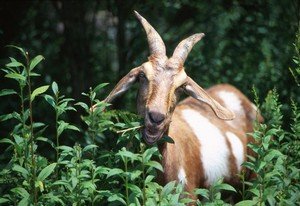 Brush
goats will eat many rank grasses and
unpalatable weeds that other livestock will not touch. The fact of the
matter is that weeds, trees, shrubs and bushes are extremely
nourishing, and this is largely due to their deep roots systems that
are deeper than pasture grass.
Brush
goats will eat many rank grasses and
unpalatable weeds that other livestock will not touch. The fact of the
matter is that weeds, trees, shrubs and bushes are extremely
nourishing, and this is largely due to their deep roots systems that
are deeper than pasture grass. 
As a result these plants are able to reach a better supply of minerals and trace elements and are more sought out by the goats who have a Brush Goats higher need for these elements than other livestock.
For those of you who feel that you are over run with blackberry plants on your farms and homesteads, blackberry is relished by goats all year round and they will quickly get rid of this plant for you from your fields and paddocks. Except for the thickest of canes goats will eat the whole plant. Raspberry canes will also be eaten in the same vane, and as these are good for your pregnant goat does, should be sought out.
Another favorite of brush goats is thistles. It is interesting to note that they will only start to eat the thistles at the late flowering stage, usually in late spring, early summer. Once goats start they will eat the whole plant from the flower down.
Bracken is a real problem for some farmers. It is highly invasive and very difficult to control. Use your brush clearing goats for braken. Although bracken is not their favorite fare they will eat large amounts of it during the late summer when there is not other green food readily available. They will only eat the old fronds as the young fronds are toxic. It is best to give goats who are eating bracken other feed to make sure that they have a better balanced diet.
The same action should be taken for brush goats who are allowed to eat St. John's Wort. It is a plant that is high in copper so light skinned goats can be affected by photo-sensitization. However, they really have to eat a lot of it to be affected. Dark skinned goats are not affected as much and can consume large quantities without being worse for wear. The goats will eat this plant in the spring at the flowering stage and eat the entire plant.
Brush goats will also eat Patterson's curse at the flowering stage. But because they don't spread the seeds in their droppings you have no fear of it springing up again the following season via the droppings.
Brush goats will eat more weeds here than what I have mentioned.
Plants and Weeds Brush Clearing Goats will Eat
* Bindweed* Canada Thistle
* Cheat Grass
* Common Candy
* Common Mullein
* Dalmatian Toad Flax
* Dandelions
* Downy Broome
* English Ivy
* Indian Tobacco
* Knapweeds
* Knotweed
* Larkspur
* Leaf Spurge
* Loco Weed
* Musk Thistle
* Plumeless Thistle
* Poison Hemlock
* Purple Loosestrife
* Reed Canary Grass
* Scotch Thistle
* Snapweed
* Sweet Clover
* Yellow Star Thistle
* Yucca
Precautions needed for your Brush Goats
Generally, brush clearing goats will eat the flowers of most weeds which helps reduce the spread of weeds as they don't get a chance to get to develop to the seed stage. Because the goat will eat the leaves too but may leave a small stem the root system soon dies off as there are no leaves for photosynthesis. However, this happens over a couple of seasons.Take precautions with your brush goats when letting them loose in weedy areas if you are not sure of how safe these plants are for your goats. One way is to put an older, more experienced goat into the paddock with the youngsters. If this goat has had experience with these weeds this will be communicated to the youngsters as to what to eat or not.
Another precaution is to feed your brush clearing goats well before letting them loose in the paddocks. This way, whatever they eat, won't affect them adversely, even if what they have eaten is toxic.
Another precaution is making sure that you don't end up putting long-haired goats into the blackberry patch. The will get horribly caught up in the brambles. It is best to have short-haired goats for this purpose or milking goats that don't have too much fine down.
Finally, near the water supply place a large tub of baking soda next to it for the brush goats to eat as a free choice. This will help in eating a single species plant for weeks on end. They will need to be given a supplementary feed of hay or other feed.
Plants that are known to be Toxic to Brush Clearing Goats
* African Rue* Andromeda
* Avocado
* Azalea
* Brouwer's Beauty Andromeda
* Boxwood
* Burning Bush berries
* Calotropis
* Cassava (manioc)
* China Berry Trees
* Choke Cherries
* Datura
* Dog Hobble
* Euonymus Bush berries
* False Tansy
* Fiddleneck
* Flixweed
* Fusha
* Holly
* Ilysanthes Floribunda
* Japanese Pieris
* Japanese Yew
* Lantana
* Larkspur
* Lasiandra
* Lilacs
* Lily of the Valley
* Lupine Seeds
* Madreselva
* Maya-Maya
* Milkweed
* Monkhood
* Mountain Laurel
* Oleander
* Pieris Japonica
* Red Maples
* Rhododendron
* Rhubarb leaves
* Wild Cherry
* Yew
Controlling Brush and Weeds with Goats is Time-Consuming
Using brush goats for weed and brush control is not a quick fix. For those of you who think that if you bring in more goats over a shorter period of time you will be able to get rid of all your weeds you are wrong. It may look as if your goats have done a good job in a relatively short time, but you still need to keep them around for a long-term erradication of weeds.Here is a personal account of using brush goats for weed control:
" In January, I bought seventy-five Angoras, as I had about twenty acres of brush land that I wanted to reclaim. I kept the goats in sheds until May. I had to put up a wire fence to keep them from visiting my neighbours, and in early May turned them into the first section of about 10 acres. I built a shed for them to stay in during nights and rains.The work they did was marvellous. In less than a month this section had the appearance of having been struck by a cyclone, and it was evident that the brush goats would soon require more land.
Consequently I wired the other section of the twenty acres, and when finished allowed them into the other piece of ground, to which they marched in military precision daily, returning to the shed at night or during the approach of rain, which they seemed to foretell as accurately as a barometer.
It was not long before it developed that my brush goats would require fresher fields or I must reduce my flock, as this ground was all that I had of that kind. Consequently I sold all but twenty-five, keeping twelve registered does, twelve kids, and one buck.
I waited anxiously for spring to arrive to see the effect of their work done last season, and I must say I was pleasantly surprised.
In the first lot fenced there is scarcely a brush left, no briars, and not even Canada thistles. The entire field between the rocks came out this spring with beautiful, thick, green, grassy foliage, mostly white clover.
On the other lot, part of the brush tried hard to show its tenacity of life by coming out with green leaves, but while writing this, the shrubs have fallen prey to the devouring brush goats, and green grass is coming out in about all the ground that they have trod.
As far as I am concerned the brush goats have done an excellent job of both clearing and cleaning up the land."
Goats should be used for sustainable weed control as seeds of some weeds lie dormant for many years and will only anchor themselves in the soil under certain climatic conditions. Therefore, you will always need your goats around to do their job. However, saying that it will only take between 3-5 years before your weed cycle is spent and will be totally eradicated.
The golden word for putting goats on your property to help with the weed problem is good management. Your goats will need to be properly fenced and they will need to be rotated through the paddocks. If you don't have these two things in place you will soon find the land stripped bare and your goats will escape, never to be seen again.
Using brush goats for weed control will not only help eradicate many weeds on your property, and keep others at an acceptable level, but unlike sheep, they do not eat the plant too close to the soil, therefore goats do not cause soil erosion. Keeping goats for weed control will also save you thousands of dollars on expensive chemical herbicides and many who have turned to brush clearing goats have had the added benefit of improved health.
Did you find this page helpful?
Sharing is a way of saying, "Thanks!"
Follow Us and Keep Up to Date
If you would like to advertise your farm in Europe for free because you need some help on the farm to pick those crops, or whatever, see our section on farming jobs worldwide. Or, if you want to advertise your farm produce, farm accommodation or a farm service look at our section Advertise your Farm. Please feel free to contact us for any further enquiries.
Leave a Comment
Do you have anything that you would like to add after reading this page? We would love to hear your thoughts. If you can add additional information to what has been written here you will be adding value to the website! No need to have any special skills - just type and submit. We will do the rest!
Leave a Comment
Do you have anything that you would like to add after reading this page? We would love to hear your thoughts. If you can add additional information to what has been written here you will be adding value to the website! No need to have any special skills - just type and submit. We will do the rest!
Don't miss out on our latest news and articles. Sign up for our free monthly e-zine!
NAVIGATION COLUMN
Find us on Google+Home
Page
Country Shopping
Country StoreFree Stuff
Free MagazinesHomesteading Blogs
Country Living Blog Gypsy's WanderingsCountry Living
Country Home Country Living Country Crafts Country HolidaysCountry Real EstateCraft ForumPicnics CampingSelf-Sufficiency
Self-Sufficient Living Organic Gardening Do It Yourself Easy RecipesHomesteading
Homesteading Today Homesteading Q & A Homestead Animals Urban Homesteading Homestead DirectoryGoing Green
Green LivingFarms Around the World
South Africa United Kingdom United States Canada Central America Australia New Zealand Europe Farm Photos Farming Articles True Farming Stories Farms for Sale Organic Farm ProduceMiscellaneous
Guest Book Search Site Survey Advertise with Us [?] Subscribe To Countryfarm Lifestyles


OTHER SECTIONS OF INTEREST
 Farm
Animals
Farm
Animals Keeping
Goats
Keeping
Goats Nigerian
Dwarf Goats
Nigerian
Dwarf Goats How to
Make Cheese
How to
Make Cheese
Click Here
New! Comments
Do you have something of value to add? Leave me a comment in the box below.