Beef and Dairy Cattle Breeds and how to Improve your Herd
Know your cattle breeds and learn how to improve your herd of beef or dairy cows through better management and feeding.
Our improved cattle breeds are descended from the wild ox of Europe and Asia, and have attained their size and usefulness by care, food, and selection. The uses of cattle are so familiar that we need scarcely mention them. Their flesh is a part of man's daily food; their milk, cream, butter, and cheese are on most tables; their hides go to make leather, and their hair for plaster; their hoofs are used for glue, and their bones for fertilizers, ornaments, buttons, and many other purposes.
There are two main classes of cattle breeds — beef breeds and dairy breeds. The principal breeds of each class are as follows:
Cattle Breeds
I. Beef Cattle Breeds
1. Aberdeen-Angus, bred in Scotland, and often called doddies.2. Galloway, from Scotland.
3. Shorthorn, an English breed of cattle.
4. Hereford, also an English breed.
5. Sussex, from the county of Sussex, England.
II. Dairy Cattle Breeds
1. Jersey, from the Isle of Jersey.2. Guernsey, from the Isle of Guernsey.
3. Ayrshire, from Scotland.
4. Holstein-Frisian, from Holland and Denmark.
5. Brown Swiss, from Switzerland.
Other breeds of cattle are Devon, Dutch Belted, Red-Polled, Kerry, Dexter, West Highland.... There are many.
In general structure there is a marked difference between the beef and dairy cattle breeds.
Beef Cattle Breeds and their Appearance
The beef cow is square, full over the back and loins, and straight in the back. The hips are covered evenly with flesh, the legs full and thick, the under line, or stomach line, parallel to the back line, and the neck full and short. The eye should be bright, the face short, the bones of fine texture, and the skin soft and pliable.
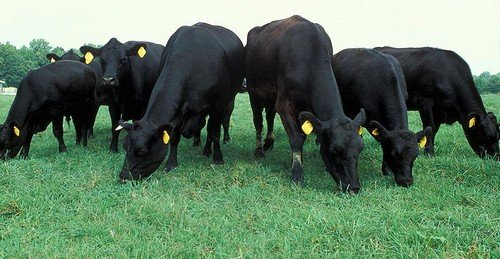
Aberdeen-Angus Cow (a Beef Type)

Dairy Cattle Breeds and their Appearance
The dairy cow or milking cow is widely different from the beef cow. She shows a decided wedge shape when you look at her from front, side, or rear. The back line is crooked, the hip bones and tail bone are prominent, the thighs thin and poorly fleshed; there is no breadth to the back, as in the beef cow, and little flesh covers the shoulders; the neck is long and thin.
The udder of the dairy cow is most important. It should be full but not fleshy, be well attached behind, and extend well forward. The larger the udder the more milk will be given.
The skin of the dairy cow, like that of the beef breeds, should be soft and pliable and the bones fine-textured.
The Dairy Type of Cattle Breed
Because of lack of flesh on the back, loins, and thighs, the cow of the dairy type is not profitably raised for beef, nor is the beef so good as that of the beef types. This is because in the dairy-animal food goes to produce milk rather than beef. In the same way the beef cow gives little milk, since her food goes rather to fat than to milk. For the same reasons that you do not expect a plow horse to win on the race track, you do not expect a cow of the beef type to win premiums as a milker.
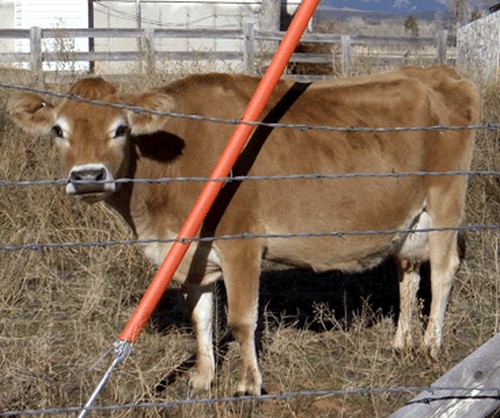
Scrub Cattle
"Scrub" cattle are not profitable for homesteading. They mature slowly and consequently consume much food before they are able to give any return for it. Even when fattened, the fat and lean portions are not evenly distributed, and "choice cuts" are few and small.
By far the cheapest method of securing a healthy and profitable herd of dairy or beef cattle is to save only the calves whose sires are pure-bred animals and whose mothers are native cows. In this way homesteaders of even little means can soon build up an excellent herd.
Cattle Breeds and How to Improve your Herd
The fact that it is not possible for every homesteader to possess pure-bred cattle is no reason why he should not improve the stock he has. He can do this by using pure-bred sires that possess the qualities most to be desired. Scrub cattle stock can be quickly improved by the continuous use of good sires. It is never wise to use grade, or cross-bred, sires, since the best qualities are not fixed in them.If a farmer kills or sells his poor cows and keeps his best ones, he will soon have a herd of only heavy milkers. Read everything you can find about taking care of cows and improving them, and then start a herd of your own.
The watchful care given to such an animal leads to more thought of the other animals on the farm, and often brings about the upbuilding of an entire herd.
Finally, what you feed your livestock is the most important aspect in maintaining their health and fertility. For us, there is no doubt that plantingherbal pasture grass is the only way to go. You are planting feed that will medicate your livestock naturally, give them a daily tonic, as well as keep internal parasites and worms down.
Conclusions about Cattle Breeds:
- (1) A cow with a tendency to get fat is not profitable for the dairy.
- (2) A thin, open, angular cow will make expensive beef.
- (3) "The sire is half the herd." This means that a good sire is necessary to improve a herd of cattle. The improvement from scrubs upward is as follows: the first generation is one-half pure; the second is three-fourths pure; the third is seven-eighths pure; the fourth is fifteen-sixteenths pure, etc.
- (4) By keeping a record of the quantity and quality of milk each cow gives you can tell which are profitable to raise from and which are not.
- (5) Good food, clean water, kindness, and care are necessary to successful cattle-raising.
Did you find this page helpful?
Sharing is a way of saying, "Thanks!"
Follow Us and Keep Up to Date
You can Add your Own Comments and Pages on Cattle Breeds!
We have lots of pages where you can contribute to throughout this homesteading website. We love hearing from our readers, and hope you will be one of those we hear from too. Look around our homesteading website. If you have any comments or questions, please feel free to contact us.
Leave a Comment
Do you have anything that you would like to add after reading this page? We would love to hear your thoughts. If you can add additional information to what has been written here you will be adding value to the website! No need to have any special skills - just type and submit. We will do the rest!
Other Comments
Click below to see comments from other visitors to this page...
Holstein/dexter cross 
I recently had the opportunity to buy a 5 month-old bull and heifer that originally came from a local dairy. Not culls. They are dexter/holstein crosses. …
Raising an Angus herd in Pakistan
I want to raise an Angus herd as my focus is on beef breed. Should I go for a pure breed or a cross of Angus and a local cow?
Moreover we don't have …
Mini Farming Livestock
Hello: We have three acres of land and I would like to add some mini livestock...preferably beef. We want to have our own meat to butcher and perhaps …
The Best Cattle Breeds Not rated yet
I AM IN KENYA AND I WOULD LIKE TO LEARN MORE IN DAIRY FARMING FRIESIAN,AYRSHIRE AND HOLSTEIN.
THANKS.
Don't miss out on our latest news and articles. Sign up for our free monthly e-zine!


OTHER SECTIONS OF INTEREST
 Farm
Animals
Farm
Animals Milking
Cows
Milking
Cows Cow
Calving
Cow
Calving How to
Milk a Cow
How to
Milk a Cow How to
Make Butter
How to
Make Butter
Making Yogurt
New! Comments
Do you have something of value to add? Leave me a comment in the box below.