Hand Raising Lambs and
Orphan Lambs - Homemade Colostrum Recipes
Raising lambs can be a tricky process. Know what to feed, how much to feed, and a colostrum recipe included so that your lambs survive.
Raising Lambs: The First Few Hours of your Orphan Lamb are Critical
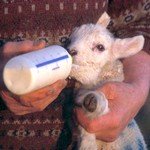 Orphan lambs can often be found lying
in frozen fields left out in the cold overnight and half to death.
Unless you intervene your lamb will die. Bring the lamb into your
kitchen and if you have a wood stove place it next to this in a
cardboard box lined with woolen blankets. If you don't have a wood
stove or fire going, place two hot-water bottles in the box with the
lamb. Cover the hot-water bottles with towels so as not to burn the
lamb. If it revives and shows signs of life, feed it with 120ml of
colostrum immediately.
Orphan lambs can often be found lying
in frozen fields left out in the cold overnight and half to death.
Unless you intervene your lamb will die. Bring the lamb into your
kitchen and if you have a wood stove place it next to this in a
cardboard box lined with woolen blankets. If you don't have a wood
stove or fire going, place two hot-water bottles in the box with the
lamb. Cover the hot-water bottles with towels so as not to burn the
lamb. If it revives and shows signs of life, feed it with 120ml of
colostrum immediately.You may have to feed it using a stomach tube, as most lambs in this state don't suck readily. You can get special lamb reviving stomach tubes from some farm or veterinary outlets. If you cannot find a stomach tube, use 600 mm or 3 mm bore plastic tubing. Round the end in a flame and punch a few holes near the end with a leather punch. Hold the lamb's head up so that the neck is straight and gently push the tube down its gullet. Make sure that the tube doesn't end up in the lungs.
Hold up the funnel and fill it with colostrum. If using a plastic tube, a syringe may be easier to feed the lamb with, since a funnel with a neck thin enough may be hard to come by for some.
Raising Lambs: Hand-Rearing Lambs or Fostering Lambs?
If the ewe's own lamb has just died, one can try and fool the ewe by tying the dead lamb's fleece on the orphan lamb until she accepts it. However, this doesn't always work and you will have to look for other devious methods, and other methods that just doesn't give the ewe much of an option! If she has a lamb of her own, having another to feed will not affect the milk production for her own lamb.
One devious method is to try and confuse the smell of the lamb. The ewe is always able to identify her own lamb out of a flock by smelling the lamb's head and rear end. To cause the confusion rub a strong-smelling liquid on the lamb's tail and head such as an antiseptic or even olive oil, and at the same time, also rub it on the ewe's muzzle. Another method, is to rub the foetal fluids of the dead lamb all over the lamb to be fostered, paying particular attention to the head and tail areas, which the ewe will sniff.
Another method is to put the ewe and the lamb together in a fairly dark, restricted area with food and water. Confine them in this area until they have bonded. This should happen over the next 2 days. If not you will then have to restrict the ewe by tying her up in such a way that the lamb has access to the milk and the ewe cannot reject or head-butt or hurt the lamb.
Raising Lambs: Bottle-Feeding your Orphan Lamb
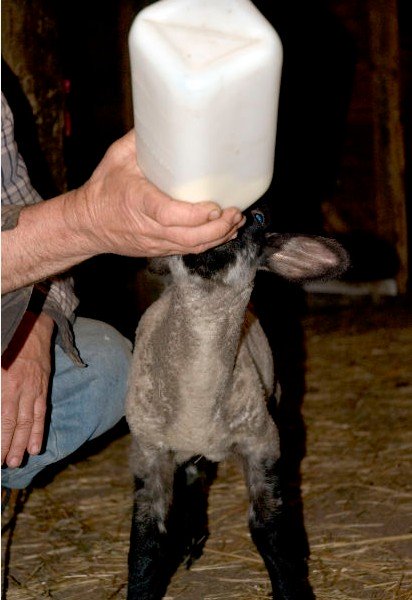
How to Feed an Orphan Lamb
If this still hasn't worked, the only option for raising lambs here is to bottle-feed your lamb. However, during these 2 days while you are trying to get your lamb to be accepted you must feed your lamb some colostrum as soon as after birth as possible. If you don't do this your lamb will most like die within a few days with a large clot in its gut. The colostrum is also very necessary as it contains anti-bodies that will protect the lamb from disease and acts as a laxative to get rid of fecal matter.
Colostrum is easy to get if you have
other lambing ewes as you can milk a ewe for the colostrum and place
this in a bottle for your orphan lamb. You can also do this and store
it in a freezer for emergencies like this. Colostrum will keep frozen
for 6 months. Allow the colostrum to thaw in a water bath
at no more
than 40 degrees Celsius so as not
to destroy the anti-bodies in the
heating process.
Raising Lambs: Homemade Colostrum Recipe
As a last resort you can make your own colostrum with the following recipe:
740 ml cows milk
1 beaten egg
1 teaspoon cod liver oil (as a laxative)
1 teaspoon glucose sugar
Mix well and either use or refrigerate until needed. When you feed your lamb it should be warmed up like a baby's bottle to just blood heat.
Another recipe for homemade colostrum:
600 ml milk
1 tsp castor oil
1 small egg
Mix together and feed as directed here.
Raising Lambs: How much Milk to Feed your Orphan Lamb
Feed your lamb the milk from the above recipe for 24 hours. After that you will need to slowly replace this with a lamb milk replacer as cow's milk is good for calves and lamb's milk is good for lambs, and not vice versa on a long term basis. Give it 200 ml four times a day. Gradually build this up to 500 ml per feed still at four times a day. Do this for 2 weeks. After this increase to 700ml three times a day for another 2 weeks. As the lamb matures start cutting back to two 500 ml feeds per day.
By the second week the lamb should be given fresh water, hay, and grass. If possible allow the lamb out with the rest of the flock during the day. After 8 weeks of feeding your lamb should be well on the road to recovery, and you should start weaning them at about 5-6 weeks of age. By week 13 your lamb should be completely weaned off milk.
If your lamb is undersized, or your orphan lamb is weak feed 60 ml every 3 hours, for 6 feeds. On the second day feed 90 ml every 3 hours for 6 feeds. After that, proceed carefully before increasing the milk intake. Continue to feed at 3 hour intervals until after week 2.
Tips for Judging How much to Feed an Ophan Lamb:
Make sure that the milk is just at blood heat, and not too hot.
If you are purchasing teats from the drug store or other stores you will have to make the teat hole bigger by using a hot darning needle. The hole should not be so small that the lamb becomes frustrated, but the hole also shouldn't be so large that the lamb chokes. As the lamb becomes older the hole can be made bigger with a pair of small scissors.
Raising Lambs: Problems with Orphan Lambs
There are 3 main problems with hand-rearing lambs.
- The first is that it might not survive the exposure to the elements and get hypothermia.
- Secondly, they don't get the colostrum in them early enough and die from a clot.
- And finally, when raising lambs they get scours, mostly due to overfeeding and unhygienic teats and bottles. Sterilize as you would your own baby's teats and bottles and you shouldn't have a problem.
Do you have any Tips and Advice for Others who are Hand Raising Orphan Lambs?
Come and share your advice and experiences on raising lambs and orphan lambs here. All you need to do is type and submit. We will do the rest!Leave a Comment
Do you have anything that you would like to add after reading this page? We would love to hear your thoughts. If you can add additional information to what has been written here you will be adding value to the website! No need to have any special skills - just type and submit. We will do the rest!
Other Comments
Click below to see comments from other visitors to this page...
Easy Homemade Milk Replacer for Lambs 
I have success with this very easy replacer. Have raised a dozen or more using this recipe.
1 & 1/3 cups of full cream milk powder
Mix up to 1 litre …
Lamb scours
I fed my two day old baby lamb the artificial colostrum for 24 hours and then switched to a lamb milk replacement. I switched cold turkey (sorry I misread …
Lamb has stopped sucking suddenly?
My 4 week old pet lamb has stopped sucking the bottle suddenly, but doesn't appear ILL he bounds up to me wagging his tail but won't suck and when you …
First Time Poddy Lamb Carer
Hi I am 14 years of age living in NSW. My father wanted to get two weaned lambs to live in our small paddock in our backyard to have as pets and keep the …
Orphan lamb colostrum question
We have found a 2 day old barbado lamb, we are 25 miles from town, only have olive oil & canola oil to make colostrum is either of these oils acceptable? …
Bowel Blockage in Poddy Lamb
We have been raising an orphaned lamb for approximately 4 weeks now. She has finally started nibbling at grass and has been doing well.
However, today …
Twin Lamb Rejected by Mother
First of all. Your website is excellent - thank you.
Just over two weeks ago, we had twin lambs born. Both good healthy lambs. Mother would only …
Weak lamb with stiff legs
We have a 6 day old corps lamb who is feeding but having problems with standing up.
She has been getting progressively stiffer In the legs and is now …
The Lamb Whispererl
Little lambs respond positively to a 2 sided tummy rub following a feed.
Freezing Orphan Lamb
I have found that trying to thaw out a frozen lamb next to a fire or with hot water bottles does not work as well as a warm bath.
I virtually resurrected …
Feeding a Poddy lamb
We found a 2 day old lamb on a neighbouring property late one evening while walking our dog.
After many unsuccessful attempts at finding his mother …
Continued feeding of rejected lamb
I've been feeding a lamb rejected by it's mother for 3 weeks. The university extention program called me to foster after it forced the mother to nurse. …
lamb won't stand up
One of our ewes had twin lambs last night. They are the weakest I've ever seen. Not only do they not stand up, they flop right over when handled and can't …
Lamb wont suck any teats
I'm hand raising a Suffolk Ram lamb which is now one week old. I've been using a new lamb milk replacer, the problem is that because he was so weak initially, …
Feeding Lambs
Alice, our North Ronaldsay lamb, was fed every three hours as a wee one, and then now at three weeks of age is on 250ml 3-4 times a day.
He takes what …
Joint-Ill in Lambs and Natural Treatments
My pet 12 week old lamb has been living in the house since she was 5 weeks old. She had joint-ill and was not drinking properly.
We brought her into …
Goat milk or lamb formula?
We are bottle feeding a baby lamb.
He did get his colostrum and was rejected at day 3. We have been feeding him goat milk.
Is this better than lamb …
my first surviving lambs Not rated yet
I've tried to save lambs even when I didn't have any idea on how to take care of them, because sheep herders, that don't have any time for them, try and …
One Stormy Night Not rated yet
On the day our lamb was born it had been raining all day. My son had called me at work telling me that one of my ewes was sick and could not stand up. …
when making homemade colostrum can I use whole milk bought from store Not rated yet
We have some orphan lambs and I was wondering when making the homemade colostrum, can you use whole milk bought from a store?
****
****
As …
The story of Rosie and Basil the Sheep Not rated yet
Last year, I took on two beautiful orphan lambs, Rosie and Basil.
They were the sickest and saddest little lambs I had ever met, and I promised them …
Free range sheep and orphan lambs Not rated yet
I farm in Normandy France where the weather is wet and windy most of the time (and temperatures can be negative). Most of our lambs arrive early in the …
when to give up on a lamb Not rated yet
We have a tiny twin Suffolk lamb we pulled soon after her birth. She was half the size of her brother at birth and her eyes were stuck shut so I think …
Feeding and Weaning Lambs Not rated yet
I have 2 bottle fed lambs that are now one month old they have begun picking at flowers and nibbling on grass.
My question is how and what do I feed …
The Orphan Lamb Angel Not rated yet
Hello Everyone,
People call me the Angel as I rescue orphaned and abandoned lambs each year from the valley. I find them all different …
Dehydration in Lambs Not rated yet
I have used Pedialite for dehydration on lambs.
The lambs enjoy the taste and drank as much as they wanted and needed with no adverse effect.
I keep …
Full Cream Powered Milk for Poddie Lambs Not rated yet
I hope this helps. We have used full cream powered milk ( the very best you can buy ) for all our poddie lambs. All have lived and none have had scours. …
Hypothermia in Lambs Not rated yet
I had a premature lamb and although it was 60 degrees outside because he had a hard time feeding he could not hold his heat, a lamb should be at least …
Kid milk repacer safe for lambs? Not rated yet
At the feed store I was given goat (kid milk replacer) I noticed that it has a small amount of copper will this hurt my baby lambs?
**
First …
Anitbotics for Lambs Not rated yet
We raise cattle and our neighbor has sheep. We offered our help because of so many babies were being born and his fields we closer to our home and we …
Query with colostrum (milk) Not rated yet
Hi, We live in central west NSW, Australia and I am presently rearing 4 orphaned lambs. I have lost 3 others over the last two weeks unfortunately and …
orphaned lamb gets scours when i give him milk Not rated yet
I am bottle feeding an orphaned lamb who seems to be a couple of weeks old.
Whenever I give him milk replacer - even watered down to a quarter strength …
When should I decrease feeding intervals for 2 week old scouring lambs? Not rated yet
I have twin lambs who are now 2 weeks old. They were saved from the meat factory and have had severe scours since the day I got them which was at 5 days …
The same way as we fed lambs 50 years ago Not rated yet
Thank you!
We have always reared lambs this way when run out of goat's colostrum but some vets tell people this is no good as it can cause infections …
8 week old rejected lamb Not rated yet
We have just had a lamb who's mother refused to let it suck. It is a twin and the mother lets his sister suckle fine.
I have been asked to bottle feed …
14 orphan lambs!! Not rated yet
This year we decided to raise orphan lambs so as to utilize our fields, but not wanting to keep ewes all winter.
We put the word out that we wanted …
Orphaned lamb Not rated yet
We recently found an orphaned lamb, it must be about 3 weeks old, sadly our ewe who has a lamb will not let the lamb drink her milk.
What type of milk …
I've been bottle feeding my lamb but ... Not rated yet
I have been bottle feeding my lamb but I noticed over the last day or so she is having a hard time having a bowel movement. Can I give her the colostrum …
A bad start with an orphan lamb Not rated yet
Our orphan lamb chops is 5 days old. She was found in a field with her placenta. Unfortunately the lady who found her fed her commercial pasturised milk. …
Follow Us: Facebook, Twitter, Google+, Pinterest, RSS
 |
 |
 |
 |
 |
Don't miss out on our latest news and articles. Sign up for our free monthly e-zine!


OTHER SECTIONS OF INTEREST
 Spinning
Yarn Instructions
Spinning
Yarn Instructions How to
Knit
How to
Knit Home
Butchering
Home
Butchering Meat
Cuts and Carving
Meat
Cuts and Carving Farm
Animals
Farm
Animals
Homesteading Today
New! Comments
Do you have something of value to add? Leave me a comment in the box below.